Believe
“ปุษยะ” ความลับที่เชื่อมโยงมหาอำนาจแห่งสุวรรณภูมิ
ข้าพเจ้าได้อ่านข่าวพบการขุดค้นทางโบราณสถาน ซึ่งในปี 2569 นี้ ได้พบเจอหลายแห่ง แต่มีอยู่ที่หนึ่ง ผมสนใจเป็นพิเศษ คือที่จ.เพชรบุรี ที่ได้ขุดพบแหวนทองคำ สลักคำว่า”ปุสรขิตส” ซึ่งเป็นภาษาพราหมีซึ่งแปลว่า “ผู้ได้รับการคุ้มครองจากดาวปุษยะ” หลายคนอาจคิดว่าเรื่องของดวงดาวเป็นเพียงแค่ความเชื่อทั่วไป แต่หลักฐานทางโบราณคดีบนแผ่นดินไทยกำลังบอกเราว่า นี่คือ “กลไกแห่งอำนาจ” ที่ถูกคำนวณมาอย่างแยบยลตั้งแต่เมื่อนับพันปีก่อนครับ!
ลองจินตนาการดูความเชื่อมโยงอันน่าทึ่งของหลักฐาน ๒ ชิ้นนี้ดูครับ:
1. ที่เมืองโบราณอู่ทอง จ.สุพรรณบุรี: เราพบจารึกที่กล่าวถึง “ปุษยคีรี” ภูเขาศักดิ์สิทธิ์ที่สัมพันธ์กับปุษยราชาฤกษ์ (กลุ่มดาวปุยฝ้าย)
2. ที่แหล่งโบราณคดีดอนยายทอง จ.เพชรบุรี: ขุดพบแหวนทองคำอายุกว่า ๒,๐๐๐ ปี ของกลุ่มชนชั้นนำมหาเศรษฐี สลักอักษรพราหมีคำว่า “ปุสรขิตส” ซึ่งแปลว่า “ผู้ได้รับการคุ้มครองจากดาวปุษยะ”
ทำไมมหาอำนาจยุคโบราณถึงต้องผูกพันกับ “ดาวปุษยะ” ขนาดนั้น?
คำตอบซ่อนอยู่ในรหัสวิชาดาราศาสตร์-โหราศาสตร์ภารตะครับ! ในระบบ ๒๗ กลุ่มดาวฤกษ์ “ดาวปุษยะ” ถือเป็นราชาฤกษ์ (ฤกษ์ที่ ๘) ซึ่งมีเทพประจำฤกษ์คือ พระพฤหัสบดี (คุรุเทพ) เทพแห่งปัญญาและคุณธรรม ที่สำคัญคือ พิกัดของกลุ่มดาวนี้สถิตอยู่ใน ราศีกรกฎ ในทางโหราศาสตร์ เมื่อดาวพฤหัสบดีโคจรเข้าสู่ราศีกรกฎจะได้ตำแหน่งที่ทรงพลังสูงสุด(ที่ ๓ องศา ๒๐ ลิปดาถึง ๑๖ องศา ๔๐ ลิบดา) หรือที่เรียกว่า “มหาอุจ” และจุดที่พระพฤหัสบดีมีกำลังเปล่งประกายถึงขีดสุด (๕ องศาของราศีกรกฎ ตามคัมภีร์โหราศาสตร์ภารตะ) ก็สถิตอยู่ตรงกลางของกลุ่มดาวปุษยะพอดีเป๊ะ!
การเลือกใช้ชื่อ “ปุษยะ” ไม่ว่าจะเป็นการสร้างศูนย์กลางเมือง สร้างศาสนสถาน หรือแม้แต่สลักลงบนแหวนประจำตัว จึงไม่ใช่เรื่องบังเอิญ แต่คือการดึงเอา “พลังแห่งปัญญาและบารมีขั้นสุด” มาปกปักษ์รักษาตัวเองและอาณาจักร
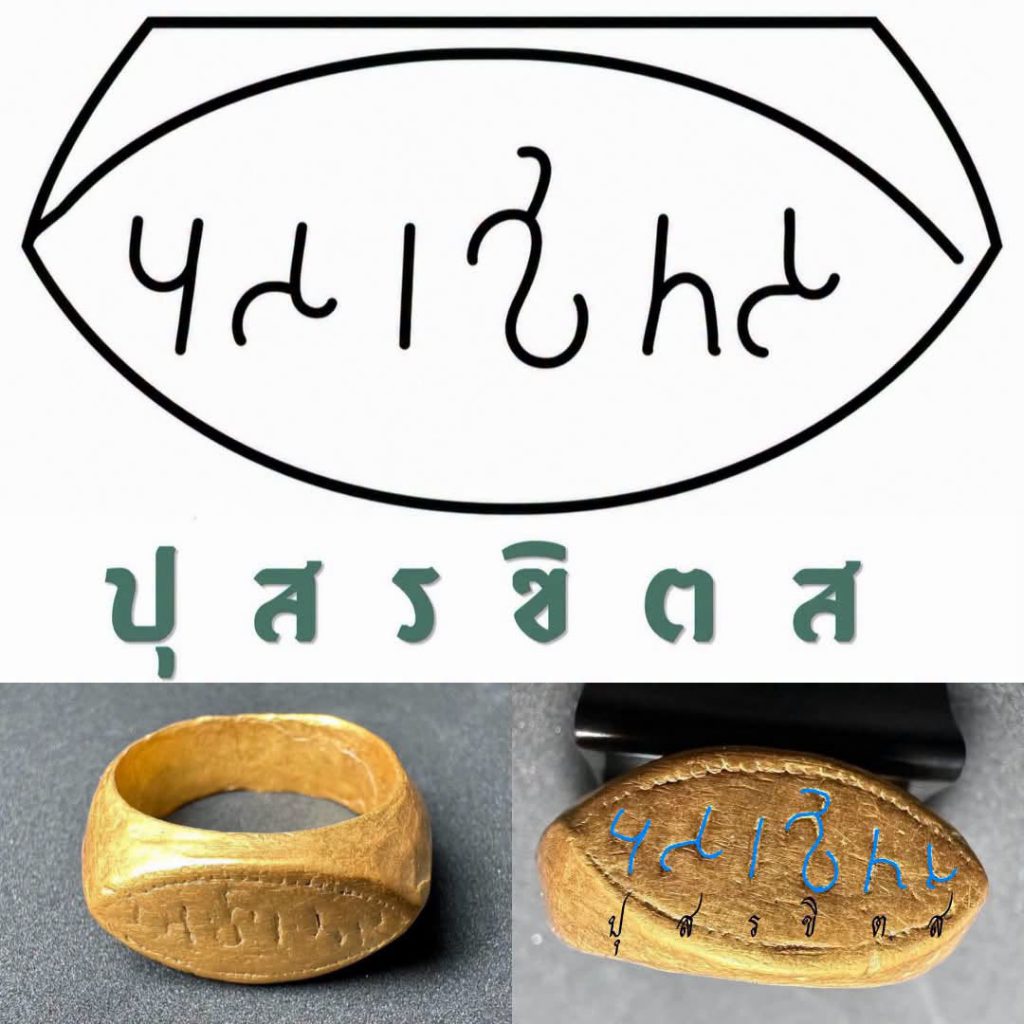
ภาพจากกรมศิลปากร
และอีกความหมายคำว่า “ปุสรขิตส” ที่จารึกบนแหวนทองคำอายุประมาณ 1,900–2,100 ปี ซึ่งพบที่แหล่งโบราณคดีดอนยายทอง จังหวัดเพชรบุรี เป็นคำที่มีความสำคัญมาก เพราะเป็นหลักฐานที่แสดงถึงการใช้ อักษรพราหมี (Brahmi) และ ภาษาปรากฤต (Prakrit) ในดินแดนสุวรรณภูมิช่วงต้นประวัติศาสตร์ คำแปลโดยตรง นักวิชาการอ่านคำนี้ว่า ปุสรขิตส ซึ่งเป็นรูปคำใน ภาษาปรากฤต มีความหมายว่า “ของปุสรขิตะ” หรือ “ทรัพย์สินของบุคคลชื่อปุสรขิตะ” คำลงท้าย ”-ส” (-sa) เป็นรูปแสดงความเป็นเจ้าของ (Genitive) คล้ายกับคำว่า
* ของนาย ก.
* belonging to…
* property of…
ดังนั้นแหวนนี้จึงน่าจะเป็น แหวนตราประทับที่ระบุเจ้าของ มากกว่าจะเป็นข้อความอวยพรหรือคาถา แล้ว “ปุสรขิตะ” แปลว่าอะไร? นักวิชาการเชื่อว่าชื่อนี้สัมพันธ์กับชื่อภาษาสันสกฤต Puṣyarakṣita (ปุษฺยรกฺษิต) ประกอบด้วยคำสองส่วน
1. Puṣya (ปุษยะ) หมายถึง
* ฤกษ์ปุษยะ
* ดาวปุษยะ (Pushya Nakshatra)
* หนึ่งใน 27 นักษัตรของอินเดีย
ถือเป็น
* ฤกษ์มงคลสูง
* ฤกษ์แห่งความเจริญ
* ฤกษ์แห่งการเริ่มต้น
* ฤกษ์ของกษัตริย์และผู้ปกครอง
ในอินเดียโบราณถือว่าเป็นฤกษ์ที่ดีที่สุดฤกษ์หนึ่ง
2. Rakṣita (รักษิต) มาจากรากศัพท์ rakṣ แปลว่า
* ปกป้อง
* คุ้มครอง
* รักษา
รวมกันจึงหมายถึง “ผู้ที่ได้รับการคุ้มครองโดยดาวปุษยะ” หรือ “ผู้ได้รับความคุ้มครองจากฤกษ์อันเป็นมงคล” หรือ “ผู้ได้รับการอุปถัมภ์จากปุษยนักษัตร” ชื่อนี้มีนัยอย่างไร? ในวัฒนธรรมอินเดียโบราณ ชื่อบุคคลไม่ได้ตั้งแบบสุ่ม แต่สะท้อน
* วันที่เกิด
* ฤกษ์เกิด
* เทพประจำตระกูล
* ความเชื่อทางโหราศาสตร์
ดังนั้นคนชื่อ Puṣyarakṣita
อาจหมายถึง
* เกิดในวันปุษยะ
* ตั้งชื่อตามฤกษ์ปุษยะ
* เชื่อว่าปุษยะเป็นดาวคุ้มครองชีวิต
ทำไมเรื่องนี้จึงสำคัญต่อประวัติศาสตร์ไทย? การพบชื่ออินเดียบนแหวนในประเทศไทย แสดงให้เห็นว่าเมื่อประมาณ 2,000 ปีก่อน ดินแดนสุวรรณภูมิมีความสัมพันธ์กับอินเดียอย่างใกล้ชิด ทั้งด้านการค้า ภาษา และวัฒนธรรม ไม่ใช่เพียงการรับอิทธิพลทางศาสนาในยุคหลังเท่านั้น นักโบราณคดีจึงสันนิษฐานว่าเจ้าของแหวนอาจเป็น
* พ่อค้าชาวอินเดีย
* หรือผู้มีเชื้อสายอินเดียที่ตั้งถิ่นฐานในสุวรรณภูมิ
* และใช้แหวนเป็นตราประทับแสดงความเป็นเจ้าของสินค้าและเอกสาร
ประเด็นที่น่าสนใจยิ่งกว่า
สิ่งที่น่าศึกษาต่อคือ ชื่อ “ปุษยรักษิต” ไม่ได้เป็นเพียง “ชื่อคน” แต่ผูกโยงกับ โหราศาสตร์อินเดีย โดยตรง ซึ่งสอดคล้องกับหลักฐานอื่นในประเทศไทย เช่น จารึกและชื่อสถานที่ที่เกี่ยวข้องกับ “ปุษยะ” และอาจสะท้อนว่าองค์ความรู้เรื่อง ฤกษ์ยามและจักรวาลวิทยา ได้เดินทางเข้าสู่สุวรรณภูมิพร้อมเครือข่ายการค้าโบราณ ไม่ใช่เพียงการนำเข้าสินค้าเท่านั้น
หากเชื่อมโยงหลักฐานหลายชิ้นเข้าด้วยกัน อาจช่วยอธิบายได้ว่าเหตุใด “ปุษยะ” จึงกลายเป็นสัญลักษณ์สำคัญของอำนาจ ความชอบธรรม และการก่อตั้งศูนย์กลางทางการเมืองในภูมิภาคนี้ตั้งแต่กว่า 2,000 ปีก่อน ซึ่งเป็นประเด็นที่น่าค้นคว้าต่อทั้งในด้านโบราณคดีและประวัติศาสตร์ความคิด.
From a Mysterious Gold Ring to a Royal Inscription:
The Hidden Code of “Pushya” That Connected the Great Powers of Suvarnabhumi
Many people think that the study of the stars belongs solely to the realm of ancient beliefs or superstition. Yet archaeological discoveries across Thailand suggest something far more profound: astronomy and astrology were not merely systems of belief—they were sophisticated instruments of political legitimacy, sacred authority, and statecraft carefully employed more than two thousand years ago.
Consider the remarkable connection between these two archaeological discoveries:
1. At the ancient city of U Thong, Suphan Buri Province, an inscription refers to “Pushyagiri” (Puṣyagiri)—a sacred mountain associated with the auspicious Pushya Nakshatra, one of the most revered lunar mansions in the ancient Indian astronomical tradition.
2. At the Don Yai Thong archaeological site in Phetchaburi Province, archaeologists uncovered a 2,000-year-old gold ring belonging to a member of the ancient elite. The ring bears a Brahmi inscription reading “Pusarakhitasa” (Puṣyarakṣitasya), meaning “Protected by Pushya” or “One who is safeguarded by the star Pushya.”
These two discoveries, separated by geography yet united by symbolism, raise an intriguing question:
Why was Pushya so important to the ruling elites of ancient Suvarnabhumi?
The answer lies within the sophisticated astronomical and astrological traditions of ancient India.
Among the 27 Nakshatras (lunar mansions), Pushya is regarded as one of the most auspicious. Often called the “King of Nakshatras,” it is the eighth lunar mansion and is presided over by Brihaspati (Jupiter)—the divine teacher of the gods, representing wisdom, virtue, prosperity, and righteous authority.
Astronomically, Pushya is located within the zodiac sign of Cancer.
In classical Indian astrology, Jupiter reaches its point of exaltation (Uccha) in Cancer, with its strongest influence occurring between 3°20′ and 16°40′ Cancer. Even more remarkably, the planet’s point of deepest exaltation (Parama-Uccha) is located at 5° Cancer, which falls almost precisely within the central region of the Pushya constellation according to traditional astrological texts.
This remarkable alignment elevated Pushya beyond an ordinary star group. It became a celestial symbol of supreme wisdom, legitimate kingship, divine protection, and moral authority.
Seen from this perspective, the repeated use of the name “Pushya”—whether in naming sacred mountains, establishing royal centers, constructing religious monuments, or engraving personal royal insignia—was almost certainly intentional rather than accidental.
It represented a conscious attempt by ancient rulers to invoke the highest cosmic blessing available: the protective power, wisdom, legitimacy, and spiritual authority embodied by Jupiter through the sacred Nakshatra of Pushya.
The archaeological evidence therefore suggests that the civilizations of ancient Suvarnabhumi were not simply adopting Indian religious ideas. They were integrating an advanced cosmological framework into the very foundations of political power, urban planning, royal identity, and sacred geography.
In this light, a small gold ring and a weathered stone inscription reveal something extraordinary:
They preserve the remnants of an ancient intellectual tradition in which the heavens and the kingdom were believed to mirror one another, and where celestial knowledge served as a language of power that connected the rulers of Suvarnabhumi with one of the greatest scientific and spiritual traditions of the ancient world.
The Meaning of “Pusarakhitasa” (ปุสรขิตส)
Inscribed on the Ancient Gold Ring
The inscription “ปุสรขิตส”, read as Pusarakhitasa (or Puṣyarakṣitasa in its Sanskritized form), appears on an ancient gold ring discovered at the archaeological site of Don Yai Hom (Don Yai Thong) in Phetchaburi Province, Thailand. Written in the Brāhmī script and the Prakrit language, the inscription dates to approximately the 1st–2nd century CE, making it one of the earliest written records found in mainland Southeast Asia.
Literal Translation The inscription is generally interpreted as: “Belonging to Pusarakhita.” or “The property of Pusarakhita.” The final suffix “-sa” (or “-s” in Prakrit orthography) is the genitive case, indicating possession. Thus, the inscription most likely served as an ownership mark on a signet ring, identifying its owner rather than conveying a religious message or blessing.
What Does “Pusarakhita” Mean?
The personal name is believed to derive from the Sanskrit form: Puṣyarakṣita (पुष्यरक्षित) It consists of two meaningful elements.
1. Puṣya (पुष्य)
Puṣya is one of the 27 Nakshatras (lunar mansions) in ancient Indian astronomy and astrology.
It symbolizes:
* Prosperity
* Auspicious beginnings
* Royal authority
* Divine blessing
* Spiritual growth
In classical Indian astrology, Puṣya is regarded as one of the most auspicious constellations, traditionally chosen for:
* Royal coronations
* Temple consecrations
* Important ceremonies
* Commencing major undertakings
2. Rakṣita (रक्षित)
Derived from the Sanskrit root rakṣ, meaning:
* To protect
* To preserve
* To guard
* To defend
Rakṣita therefore means: Protected or One who is under divine protection.
Combined Meaning
Together, Puṣyarakṣita may be translated as:
* “Protected by Puṣya.”
* “One safeguarded under the auspicious star Puṣya.”
* “Protected by an auspicious constellation.”
* “The fortunate one under the blessing of Puṣya.”
Rather than being merely a personal name, it carries a profound astrological and religious significance.
Historical Significance
This inscription provides compelling evidence that, nearly 2,000 years ago, the region known historically as Suvarṇabhūmi had already established strong cultural and commercial connections with the Indian subcontinent.
The gold ring demonstrates that:
* The Brāhmī script was in use in mainland Southeast Asia.
* Prakrit, rather than Sanskrit, was employed in everyday communication.
* Indian merchants, administrators, or settlers were present in the region.
* Personal names influenced by Indian astrology were already being used locally.
The ring itself was likely a personal seal, used to authenticate ownership of goods, documents, or commercial transactions.
A Deeper Interpretation
The significance of Puṣyarakṣita extends beyond simply identifying an individual. The inclusion of Puṣya, one of the most sacred lunar mansions in Indian astrology, suggests that celestial symbolism had become intertwined with concepts of identity, legitimacy, and authority. When considered alongside other archaeological evidence from Thailand—such as inscriptions referring to Puṣyagiri (“The Sacred Mountain of Puṣya”)—the name points to the possibility that astronomical knowledge, astrology, political ideology, and religious belief traveled together along the ancient maritime trade routes connecting India and Southeast Asia.
Consequently, the inscription “Pusarakhitasa” is more than an owner’s mark. It is a remarkable testament to the transmission of language, astrology, religion, and elite culture across the Indian Ocean, offering a rare glimpse into the intellectual and spiritual landscape of early Southeast Asia nearly two millennia ago.